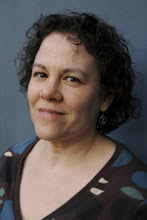
Francine Prose says writing can’t be taught, but the Washington Post still manages to find some lessons in an interview:
- You can write about what's really happened to you without being constrained by the facts.
- You don't need to know much when you begin.
- Forget plotting. It's all about the sentences.
- Don't even begin to think you can learn to write by taking an undergraduate writing workshop.
Read more here.
Friday, September 26, 2008

Thursday, September 25, 2008
A writer's nightmare - come true!
Imagine you’re working on a book. And you’ve been working on it for years. Not a novel, but a non-fiction book about a person now lost in the mists of time. Only - you’re not the only one!!
[Full disclosure: cue screams!]
[Full disclosure: cue screams!]
Monday, September 22, 2008
A book to love - or to hate
Some people use this writing formula to help shape their book: "This is a story about (main character) who wants (story goal) more than anything in the world, but is prevented by (obstacle) until she (does something to overcome obstacle)."
Obviously, Kathryn Davis, author of The Thin Place , has never heard of this formula. And good for her. There’s no clear main character, and while the characters all have goals, they might feel a bit ambivalent about them, or they might be transitory. And not all obstacles are overcome.
It begins with three girls finding a dead man on the beach. One of them stays behind to watch the body – and ends up bringing it back to life. But the book isn’t really her story. It’s more the story of a small town. POV shifts and skips from one character to another – including Margaret, a dog, and Gigi, the cat. There are miracles and evil and a terrible accident when a woman tries to retrieve one last Pepperidge Farm goldfish from the floor of her car. The story skips back and forth in time, including a future where all the characters are dead (even the idea was kind of jarring, although it made me realize how much I deny that will happen in real life), to the past when the very world itself was created.
It’s a magical book, like nothing I’ve ever read, like nothing I’ve ever written. Judging from Amazon, people either love it or hate it. Count me in the first camp.
Obviously, Kathryn Davis, author of The Thin Place , has never heard of this formula. And good for her. There’s no clear main character, and while the characters all have goals, they might feel a bit ambivalent about them, or they might be transitory. And not all obstacles are overcome.
It begins with three girls finding a dead man on the beach. One of them stays behind to watch the body – and ends up bringing it back to life. But the book isn’t really her story. It’s more the story of a small town. POV shifts and skips from one character to another – including Margaret, a dog, and Gigi, the cat. There are miracles and evil and a terrible accident when a woman tries to retrieve one last Pepperidge Farm goldfish from the floor of her car. The story skips back and forth in time, including a future where all the characters are dead (even the idea was kind of jarring, although it made me realize how much I deny that will happen in real life), to the past when the very world itself was created.
It’s a magical book, like nothing I’ve ever read, like nothing I’ve ever written. Judging from Amazon, people either love it or hate it. Count me in the first camp.
Friday, September 19, 2008
Death by Latte

I have been drinking waaaay too much coffee lately. But at least I’m not the character in Linda Gerber’s DEATH BY LATTE who turns up dead in a coffee shop. The book is a modern-day romantic mystery/suspense in the tradition of Victoria Holt and Philippa Carr.
Aphra Connolly, who had been living a quiet existence on her father’s secluded island resort, until Seth Mulo turns up and steals her heart… and provides information that leads her to find her mom in Seattle. But the reunion isn’t quite what she expected. Aphra’s mom, Natalie, doesn’t seem happy to see Aphra, and Natalie’s boyfriend, Joe, insists that Aphra go home. Even worse, Seth shows up, only to ask her to return the ring he had given her that summer. At least Natalie’s good-looking neighbor is sympathetic. But when Joe is found dead at a nearby coffee shop, Aphra discovers her whole trip to Seattle has been based on a lie. And now someone just might be trying to kill her. . . .
I asked, Linda answered
A. What's the scariest thing that's ever happened to you? Bonus question: have you used it, in any way, in a book?
L. My mom won't read this, right? When I was in high school, my family was going on a trip and I didn't want to go. I had a job and drill team practice and I talked them into letting me stay behind. I was supposed to sleep at a neighbor's house but that was really awkward, so I lied and told the neighbor I was sleeping at a friend's house one night and went home. I had to be careful not to turn on any lights so the neighbor wouldn't know I was there. In the middle of the night, a noise woke me up and I realized someone else was in the house. The phone was clear on the other side of the room and I didn't dare move for fear that the person would hear me and come upstairs. But on the other hand, I reasoned, they might come upstairs anyway and I would be helpless. I eased out of bed and although I tried to be silent as I tiptoed toward the phone, the house was old and the floorboards squeaked. Fortunately, whoever it was took off when they realized someone was home instead of getting aggressive. They ran out the front door, leaving it wide open. I remember sitting at the top of the stairs, shaking, looking at that front door and trying to work up the courage to go down and shut it.
I haven't used that experience in a book. Yet.
A. Mystery writers often give their characters an unreasoning fear - and then make them face it. Do you have any phobias, like fear of spiders or enclosed spaces?
L. I don't know what my phobia is called. I'm not exactly afraid of heights, but I am afraid of falling from heights. I've had dreams where I'm on an elevator with no walls or on a steep staircase with no railing or on this certain looong, steep escalator in the Tokyo train station, and it terrifies me. Any dream interpreters out there? What does that mean?
A. Do you have a favorite mystery book, author, or movie?
Get Shorty by Elmore Leonard - book and movie. Great stuff.
A. At its heart, every story is a mystery. It asks why someone acts the way they did - or maybe what will happen next. What question does your book ask?
L. A recurring question in DEATH BY LATTE is – who can Aphra trust? And - who is the Mole and what does he really want?
A. Is there a mystery in life that you are still trying to figure out?
L. Yeah. Why do I still procrastinate when I know it's just going to stress me out? Ongoing theme in my life!
Wednesday, September 17, 2008
Sky = Falling?
New York magazine has a long article about the state of publishing.
In the past dozen years, all I've heard is lamenting about the state of the industry. I'm not sure what anyone can do about it, or even if it's as bad as they say. One thing about writing YAs - at least in school there is still the idea that kids should read for pleasure. There is a lot of effort expended on coaxing the reluctant reader. The world seems to have given up on adults who don't like to read.
Some excerpts from the article:
“There used to be a reason to get into publishing,” says Carroll [formerly of Carroll & Graf. Full disclosure: I once spoke to him on the phone because he was used as a reference - but I no longer remember for what.] “Whether they know it or not, they all want to be Maxwell Perkins. It’s a kind of secondary immortality. They didn’t flock to publishing because they want to publish Danielle Steel.”
“Some people say there’s not enough marketing done for a book, and I think that’s total bullshit. You do the marketing that works, and not much is working right now.” says Peter Miller, director of publicity for Bloomsbury. He also says [and part of me agrees]that book trailers "are all the rage right now, but I would love to see an example of one video that really did generate a lot of sales. There’s a sense of desperation.”
The article discusses some facts that probably haven't changed for a while:
"The remaindering and shredding of books—a cost borne largely by the publisher—is a relic of a consignment model developed during the Depression that makes no modern sense. Publishers also pay for placement in big bookstores, which they call “co-op,” under a complicated arrangement meant to cover up the fact that it’s payola (or, as some call it, extortion). Those 300 copies of, say, American Wife stacked precariously at the entrance? Bought and paid for by the publisher. “You feel raped having to pay for placement in a store you’re selling to,” says an agent."
Read morehere.
Maybe I'm wrong, but I think there will always be a market for stories. But the market might look different.
In the past dozen years, all I've heard is lamenting about the state of the industry. I'm not sure what anyone can do about it, or even if it's as bad as they say. One thing about writing YAs - at least in school there is still the idea that kids should read for pleasure. There is a lot of effort expended on coaxing the reluctant reader. The world seems to have given up on adults who don't like to read.
Some excerpts from the article:
“There used to be a reason to get into publishing,” says Carroll [formerly of Carroll & Graf. Full disclosure: I once spoke to him on the phone because he was used as a reference - but I no longer remember for what.] “Whether they know it or not, they all want to be Maxwell Perkins. It’s a kind of secondary immortality. They didn’t flock to publishing because they want to publish Danielle Steel.”
“Some people say there’s not enough marketing done for a book, and I think that’s total bullshit. You do the marketing that works, and not much is working right now.” says Peter Miller, director of publicity for Bloomsbury. He also says [and part of me agrees]that book trailers "are all the rage right now, but I would love to see an example of one video that really did generate a lot of sales. There’s a sense of desperation.”
The article discusses some facts that probably haven't changed for a while:
"The remaindering and shredding of books—a cost borne largely by the publisher—is a relic of a consignment model developed during the Depression that makes no modern sense. Publishers also pay for placement in big bookstores, which they call “co-op,” under a complicated arrangement meant to cover up the fact that it’s payola (or, as some call it, extortion). Those 300 copies of, say, American Wife stacked precariously at the entrance? Bought and paid for by the publisher. “You feel raped having to pay for placement in a store you’re selling to,” says an agent."
Read morehere.
Maybe I'm wrong, but I think there will always be a market for stories. But the market might look different.
Tuesday, September 16, 2008
My first time
My very first signing was in early 1999 at Powells Books. Yes, that Powells Books. Where every famous authors who comes to Portland stops. And there I was, waiting in the wings, wearing a long brown velvet dress with my hair pinned up. I was sure I was going to die or at least pass out. Well over a hundred people turned up (many of them people from work who erroneously thought I would soon be a millionaire and quit). The whole time I was speaking, a little voice in the corner of my mind was yammering away that I felt sick, I felt dizzy, I should lay my head on the podium, I would soon pass out and my husband would drag my body away.
But I made it.
And now I kind of like speaking in public. And would kill for having a turnout like that when I’m the only one speaking.
But I made it.
And now I kind of like speaking in public. And would kill for having a turnout like that when I’m the only one speaking.
Friday, September 12, 2008
Tips on how to look for an agent
I am lucky enough to have the most wonderful agent in the world, Wendy Schmalz, but I know a lot of people out there are still looking for an agent.
Here’s some great advice on how to go about doing it. And she also has some excellent tips on how to vet an agent. Using one of her tips, I found that my agent’s name was mentioned 38 times in books that Amazon has scanned.
Here’s some great advice on how to go about doing it. And she also has some excellent tips on how to vet an agent. Using one of her tips, I found that my agent’s name was mentioned 38 times in books that Amazon has scanned.
Subscribe to:
Posts (Atom)